

Thursday, December 11, 2025
  • English
  • Marathi
No Result
View All Result
Daily PRABHAT
  • Home
  • Latest News
  • National
  • International
  • Entertainment
  • Politics
  • Sports
  • Business
  • More
    • Health
    • Lifestyle
    • Technology
    • Science
Daily PRABHAT
No Result
View All Result
  • Home
  • Latest News
  • National
  • International
  • Entertainment
  • Politics
  • Sports
  • Business
  • More
Home International

Strict lockdown policy cut down China’s GDP by half

by Digital Desk
4 years ago
in International, Top News
A A
Strict lockdown policy cut down China’s GDP by half
Share on FacebookShare on Twitter

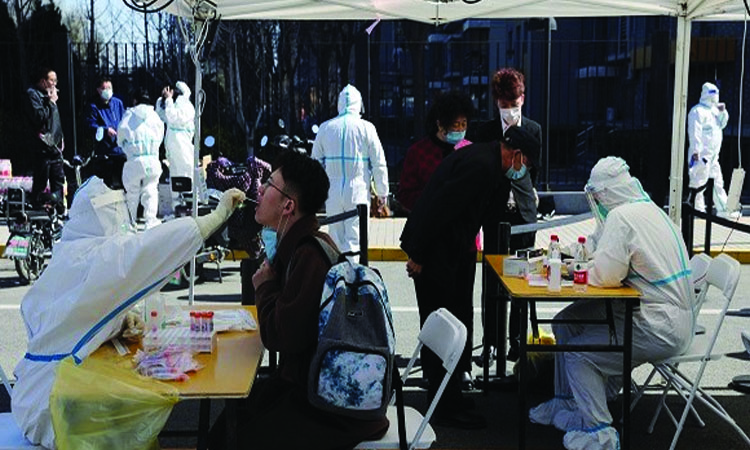
Beijing : In the last few weeks, China has seen its worst COVID outbreak since the initial height of the pandemic in early 2020 when the economy slumped. The latest surge in cases could hit first-quarter gross domestic product by at least half of a percentage point. The strict lockdowns are likely to cost the country at least USD 46 billion a month or 3.1 per cent of GDP and the impact could be double if more cities tighten restrictions according to an economist at the Chinese University of Hong Kong.

The Lockdown of Shanghai’s 26 million people is testing the limits of China’s hardline “zero-COVID” strategy, which is shaking markets far beyond the country’s borders. China’s largest city alone could reduce China’s real GDP by 4 per cent. Millions of Shanghai residents have to stay home and undergo coronavirus testing as the financial hub tries to stamp out a growing Omicron outbreak.
Trucking data in Shanghai, nearly 2 million trucks that crisscross China and whose movements are highly correlated with local economic activity, indicates economic activity fell 40 per cent below normal even before the lockdown began, according to the estimates. As per the report, more cities may follow Shenzhen’s approach, stopping public transportation and preventing people from entering and leaving the city. The lockdown will deal a double blow to consumption and production, and its spillover effect will increase the risk to the global supply chain, the report warned.

In Changchun, the capital of Jilian province, which imposed a lockdown over Omicron cases on March 11, economic activity levels plunged over 66 per cent from normal levels. Over 9 million residents were confined to homes and undergo three rounds of mass testing, while non-essential businesses have been closed and transport links suspended. Changchun, the industrial centre of northeast China accounted for 11 per cent of China’s annual auto production.

A week-long lockdown in Shenzhen, during which residents were tested three times, reduced economic activity by 34 per cent. In a worst-case scenario, economists predict, the lockdown of all cities for one month would cut China’s GDP by 53 per cent. If China’s four largest cities underwent a strict lockdown together, inflation-adjusted GDP would fall 12 per cent.

The economic costs of China’s dynamic ‘Zero-COVID’ policy are too high. Investors’ doubts about large-scale city closures also caused China’s stock market to plummet sharply.

How long will China keep up its Zero Covid policy?

Meanwhile, a raft of tightened restrictions and targeted lockdowns have led many experts and residents to question the sustainability of such an approach as China enters the third year of the pandemic. Some Chinese public health experts called the latest rebound the most severe onslaught since the early epidemic in Wuhan and even after two years of fighting the epidemic with rigorous measures, different sectors have shown a certain level of fatigue toward the Zero-COVID strategy, which could affect the outcome of the implementation of the current policy.

The drawbacks of a Zero-COVID approach have been laid bare in Hong Kong, where mixed messages had fueled hoarding of food supplies and public fear that people would be taken away to isolation. That’s the question now facing Chinese officials and previous fail-safe systems begin to buckle under the strain of their own uncompromising rules.

Tags: China'slockdown
ShareTweetSendShareSend

Latest News

Goa Police probe reveals Luthra brothers booked Thailand tickets minutes after blaze broke out

Uttarakhand CM launches ‘Meri Yojana’ portal, unveils three editions of scheme handbook

MLA Mahesh Singh Jeena meets CM Pushkar Singh Dhami, presents traditional hill products from Uttarakhand

Uttarakhand: Seminar at Soban Singh Jeena University highlights four years of CM Dhami government

Delhi Police seize over Rs 3.5 crore in demonetised notes; four held for illegal exchange racket

Uttarakhand CM Dhami seeks Centre’s nod for multi-organ transplant unit at AIIMS Rishikesh

Delhi-NCR air quality improves slightly, remains in ‘poor’ category; layer of smog covers city

J-K: New steel bridge to provide relief to commuters in Ramban district

Australia unveil Under-19 World Cup squad; Oliver Peake to lead

Blair Tickner unlikely to participate in second Test against West Indies due to shoulder injury

Beijing : In the last few weeks, China has seen its worst COVID outbreak since the initial height of the pandemic in early 2020 when the economy slumped. The latest surge in cases could hit first-quarter gross domestic product by at least half of a percentage point. The strict lockdowns are likely to cost the country at least USD 46 billion a month or 3.1 per cent of GDP and the impact could be double if more cities tighten restrictions according to an economist at the Chinese University of Hong Kong. The Lockdown of Shanghai's 26 million people is testing the limits of China's hardline "zero-COVID" strategy, which is shaking markets far beyond the country's borders. China's largest city alone could reduce China's real GDP by 4 per cent. Millions of Shanghai residents have to stay home and undergo coronavirus testing as the financial hub tries to stamp out a growing Omicron outbreak. Trucking data in Shanghai, nearly 2 million trucks that crisscross China and whose movements are highly correlated with local economic activity, indicates economic activity fell 40 per cent below normal even before the lockdown began, according to the estimates. As per the report, more cities may follow Shenzhen's approach, stopping public transportation and preventing people from entering and leaving the city. The lockdown will deal a double blow to consumption and production, and its spillover effect will increase the risk to the global supply chain, the report warned. In Changchun, the capital of Jilian province, which imposed a lockdown over Omicron cases on March 11, economic activity levels plunged over 66 per cent from normal levels. Over 9 million residents were confined to homes and undergo three rounds of mass testing, while non-essential businesses have been closed and transport links suspended. Changchun, the industrial centre of northeast China accounted for 11 per cent of China's annual auto production. A week-long lockdown in Shenzhen, during which residents were tested three times, reduced economic activity by 34 per cent. In a worst-case scenario, economists predict, the lockdown of all cities for one month would cut China's GDP by 53 per cent. If China's four largest cities underwent a strict lockdown together, inflation-adjusted GDP would fall 12 per cent. The economic costs of China's dynamic 'Zero-COVID' policy are too high. Investors' doubts about large-scale city closures also caused China's stock market to plummet sharply. How long will China keep up its Zero Covid policy? Meanwhile, a raft of tightened restrictions and targeted lockdowns have led many experts and residents to question the sustainability of such an approach as China enters the third year of the pandemic. Some Chinese public health experts called the latest rebound the most severe onslaught since the early epidemic in Wuhan and even after two years of fighting the epidemic with rigorous measures, different sectors have shown a certain level of fatigue toward the Zero-COVID strategy, which could affect the outcome of the implementation of the current policy. The drawbacks of a Zero-COVID approach have been laid bare in Hong Kong, where mixed messages had fueled hoarding of food supplies and public fear that people would be taken away to isolation. That's the question now facing Chinese officials and previous fail-safe systems begin to buckle under the strain of their own uncompromising rules.
No Result
View All Result
  • Home
  • Latest News
  • National
  • International
  • Entertainment
  • Politics
  • Sports
  • Business
  • More
    • Health
    • Lifestyle
    • Technology
    • Science